
Managing runtimes
List, start, pause, resume, reset, and connect to workspace runtimes from the CLI and TUI.
Use the CLI to manage runtime compute and the TUI or App to attach an interactive session. A runtime’s credential belongs to the sandbox, not to whichever client asked for it, so another device owned by the same user can connect without interrupting the first.
List what’s there
Section titled “List what’s there”dn runtime listdn runtime list --minedn runtime list --jsondn runtime get airt-scout-80The list shows every runtime in the active workspace with its status,
name, key, and project. Details include the current sandbox, expiry,
and billing totals when the runtime is running. get takes either the
runtime key shown in the list or its UUID.
A runtime belongs to whoever created it. You can see your colleagues’
runtimes, because reading spans the workspace, but you cannot start,
pause, resume, or reset one — those answer 403. Runtimes you do not own
are marked read-only in the list, and --mine leaves them out
altogether. With --json, each row carries owned_by_me and
created_by.
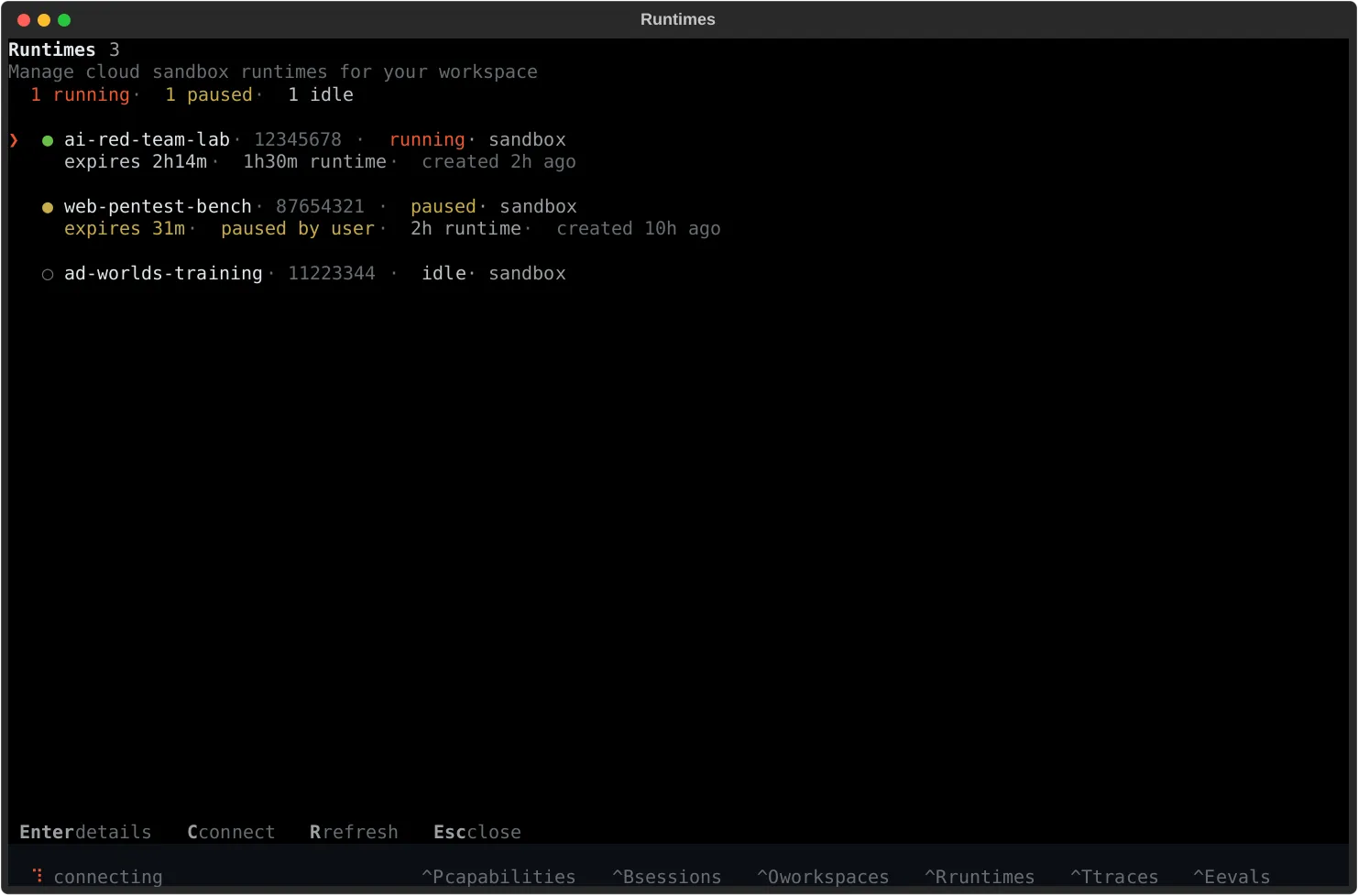
From the TUI, press Ctrl+R (or /runtimes) to open the runtimes
screen. Type into the search row to filter by runtime ID, project,
provider, or state — structured filters like state:running,
provider:e2b, project:default, and connected:yes work in the
same field. The list refreshes automatically every few seconds, and
n creates a new runtime in the active project without leaving the
screen.
Start a runtime
Section titled “Start a runtime”# start a specific runtime by its key, as shown in `dn runtime ls`dn runtime start airt-scout-80
# ...or by UUIDdn runtime start 7c1e2d4f-9e0a-4b6d-8c3f-2a1b5d7e9f01
# start the only runtime in a project, or create the first onedn runtime start my-project
# ensure and start from a runtime.yamldn runtime start --file runtime.yamlStarting an idle runtime provisions a fresh sandbox.
Starting a running runtime leaves the live sandbox untouched and returns
its credential. Retrying start after a lost response is safe: the retry
returns the same credential and disconnects nobody.
Runtime credentials belong to the user who started the current sandbox. Another device signed in as that user can attach; another workspace member cannot. Reset the runtime when ownership needs to change.
If the durable configuration, capability set, or build source changed since the sandbox was provisioned, the CLI reports the drift but does not rebuild automatically. Applying the change costs everything inside the current sandbox, so use an explicit reset:
dn runtime reset airt-scout-80 # prompts; -y to skipdn runtime start airt-scout-80 # provision against the current configFrom the TUI, use the runtime’s Reset action, then start it.
<target> is read as a runtime key or UUID first, and falls back to a
project. When a project has several runtimes, name the one you want
directly rather than passing --runtime-id.
From the TUI, select a runtime and press s (or use the detail view’s
Start runtime action) to start it.
Connect to a running runtime
Section titled “Connect to a running runtime”Connection state is tracked separately from runtime state — a runtime
can be running without being the one your current TUI session is
attached to.
- From the TUI, press
con a running runtime, or open its detail view and pickConnect. - From the App, open the runtime and use the session picker.
- To connect from a different machine, point
dnat the runtime server URL:dn --runtime-server https://…(covered in Local runtime server).
The TUI’s detail view is state-aware: idle runtimes offer Start,
running runtimes offer connect/disconnect, pause, logs, reset, and
Extend expiration, and paused runtimes offer resume, logs, and
reset.
Pause, resume, and extend
Section titled “Pause, resume, and extend”Pause suspends the sandbox without losing state. Credits stop accruing immediately. Resume restores the same sandbox — session history, capability bindings, and working state all come back.
dn runtime pause airt-scout-80dn runtime resume airt-scout-80dn runtime keepalive airt-scout-80 --extend-seconds 900Resume restores compute but does not return a credential. Run
dn runtime start airt-scout-80 afterward when the caller needs one.
Fetching it disconnects nobody.
Extend expiration (+5 min) pushes the sandbox’s expiry window out
when you need more time. Sandboxes start with a one-hour window by
default, and the platform caps any extension at your organization’s
sandbox runtime limit — and, on the hosted platform, at what your
remaining credits cover. Use it proactively; the sandbox is
terminated automatically when it times out, and termination
is final for that sandbox.
Reset for a clean environment
Section titled “Reset for a clean environment”Reset discards the current sandbox and returns the runtime to idle
without losing the runtime’s identity, bindings, or project
association. It also destroys that sandbox’s credential, which disconnects
every attached client — reset is how access is withdrawn.
The next start reprovisions fresh compute against the current durable
configuration.
Reset from the TUI detail view. The runtime’s own identifier — and anything attached to it, like sessions and capability installs — is preserved.
When a sandbox is terminated
Section titled “When a sandbox is terminated”Sandboxes transition to the final killed state when they time out,
when you delete them explicitly, or when your organization runs out
of credits. A runtime whose sandbox was killed returns to idle — a
subsequent start will provision a new sandbox.
Running out of credits terminates the sandbox. The record may show it
paused with a pause_reason of insufficient_credits — that marks
why compute stopped, but the sandbox itself is gone. After a top-up,
start the runtime again: durable configuration and capability
bindings come back with the fresh sandbox, in-sandbox working state
does not.
Cleaning up
Section titled “Cleaning up”Runtime records can’t be deleted — an idle runtime holds no compute
and costs nothing, and the record is removed with its project. To
reclaim compute, reset the runtime or delete the sandbox directly:
dn sandbox delete 3f8a1c2e-7b4d-4e0f-9a6c-1d2e3f4a5b6cDeleting a sandbox is the CLI equivalent of a reset: the runtime
returns to idle and keeps its identity and bindings.
See also
Section titled “See also”- Configuration — what persists across sandbox replacement
- Sandboxes — the compute ledger behind every runtime
dn runtimereference — every subcommand and flag